






By Steve Carver, “Mr. Bouncer”
Some of my clients, and even a few colleagues, have brought up vibration plates in casual conversation recently. They’ve been showing up all over influencer “must-have” lists and Amazon recommendations, so it’s not surprising people are curious.
When something suddenly gets that much visibility, the next question is usually the same: How does this compare to what I’m already doing?
For many people using a rebounder, that question turns into a comparison between rebounding and vibration plates.
While they’re often grouped together as low-impact wellness tools, they work on the body in very different ways — and understanding that difference matters when you’re deciding which option actually supports your goals.
Why people confuse rebounding and vibration plates
At a glance, the comparison makes sense. Both rebounding and vibration plates are commonly promoted as:
-
low-impact alternatives to traditional workouts
-
supportive of circulation and lymphatic movement
-
efficient options that don’t require long sessions
Because of this overlap in marketing, it’s easy to assume they’re interchangeable.
They’re not.
The biggest difference comes down to how the body is engaged: one relies on active movement, the other on external stimulation.
How rebounding actually works
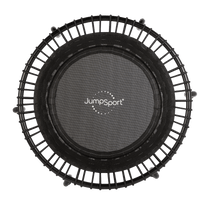
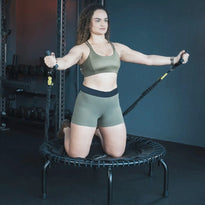
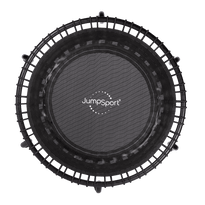
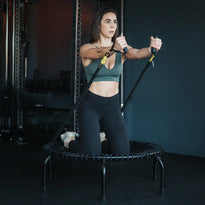
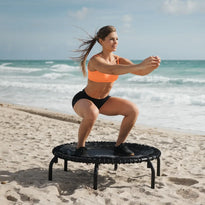
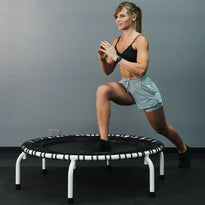
Rebounding is an active, self-generated movement. Your body creates the motion, controls the rhythm, and adapts continuously with each bounce.
When you rebound:
-
muscles contract and relax rhythmically
-
joints move through natural ranges with mat support
-
balance and coordination are constantly engaged
-
heart rate elevates in response to movement
This makes rebounding a full-body movement practice, not just a stimulus applied to the body.
You usually feel this immediately — your feet, balance, breathing, and core all start communicating with each other.
Research conducted for NASA in the 1980s comparing trampoline exercise with treadmill running found that bouncing exercise could produce strong cardiovascular responses while distributing acceleration forces differently across the body compared to running on hard surfaces.
In other words, rebounding can provide meaningful conditioning while reducing harsh impact forces.
How vibration plates actually work
Vibration plates deliver external mechanical vibration while you stand, sit, or hold positions on the platform.
With vibration plates:
-
the machine creates the stimulus
-
muscles respond reflexively to vibration
-
movement is often minimal or static
-
cardiovascular engagement is limited
According to the Mayo Clinic, whole-body vibration may offer some fitness benefits but it’s not clear that it provides the same benefits as exercise you actively perform, such as walking, strength training, or aerobic activity.
Because of this, vibration plates are typically used in short sessions and positioned as a supplement rather than a complete movement solution.
Are vibration plates safe?
Vibration plates are generally considered safe for healthy individuals when used appropriately and for short durations.
However, medical sources advise caution for certain individuals.
The Mayo Clinic notes that whole-body vibration may not be appropriate for people who are pregnant, have blood clots, pacemakers, recent surgeries, or certain cardiovascular conditions, and recommends consulting a healthcare professional before use.
Because vibration plates transmit mechanical oscillations through the ankles, knees, hips, and spine, individuals with joint issues or spinal conditions should be especially mindful of exposure duration and intensity.
For most healthy users, occasional use may be fine — but vibration plates are usually best viewed as a supplement to movement-based exercise, not a replacement for it.
The key distinction: movement vs. stimulation
This is the most important difference to understand.
Rebounding supports the body through movement.
Vibration plates stimulate the body without requiring movement.
That distinction matters because movement:
-
trains coordination and balance
-
supports cardiovascular health
-
reinforces motor patterns
-
adapts naturally as the body changes
Stimulation can play a role in certain contexts, but it does not replace the broader benefits of active movement.
A quick note on lymphatic claims
It’s also worth noting that most research on vibration plates and lymphatic movement involves very specific or clinical populations — such as individuals with limited mobility, post-surgical swelling, or neurological conditions.
For generally healthy people who can move freely, the lymphatic system already responds well to:
-
regular muscle contraction
-
joint motion
-
breathing patterns
That’s exactly what happens during rebounding.
In those cases, active movement tends to do the heavy lifting, while passive stimulation adds little beyond temporary sensation.
Rebounding vs. Vibration Plates: Side-by-Side Comparison
| Goal | Rebounding | Vibration Plate |
|---|---|---|
| Joint friendly | Elastic mat absorbs impact | Impact varies with frequency, posture, and health status |
| Cardiovascular support | Active movement elevates heart rate | Minimal unless combined with additional exercise |
| Balance & coordination | Continuously engaged | Limited without active movement |
| Lymphatic movement | Muscle contraction and natural motion support lymphatic flow | Can support lymphatic flow in specific positions or sessions |
| Habit-building | Easy to repeat daily | Often used in shorter sessions or as a supplement |
| Long-term movement | Sustainable daily practice | Best as an addition to consistent movement routines |
Which one is “better”?
The more useful question is: better for what?
Vibration plates may be helpful:
-
as a short-term supplement
-
for individuals with very limited mobility
-
in certain rehabilitation or therapeutic settings
Rebounding is better suited for:
-
daily movement
-
cardiovascular and lymphatic support
-
balance and coordination
-
long-term wellness and habit formation
For most people:
Vibration plates are a tool. Rebounding is a practice.
Why movement matters for long-term wellness
From a product development perspective, long-term health depends on:
-
what you can repeat consistently
-
what your joints tolerate over time
-
what adapts as your body changes
Movement-based practices like rebounding support resilience because they involve:
-
active participation
-
real-time feedback from the body
-
progression without excessive stress
That’s something no passive modality can fully replace.
Where rebounding fits into a wellness routine
Rebounding can stand on its own as:
-
a daily cardio option
-
a balance and coordination practice
-
a gentle recovery or circulation session
It can also complement other forms of training without competing with them.
For many people, that versatility is exactly what helps rebounding become a long-term habit rather than a short-lived experiment.
Final thought from Mr. Bouncer
There’s nothing wrong with tools that provide stimulation. They can have their place.
But when it comes to building strength, resilience, and long-term wellness, movement matters.
Rebounding works because it keeps the body moving safely, consistently, and in a way that supports you over time.
That’s the difference.
About the Author
Steve Carver is the Business and Product Development Director and Master Trainer at JumpSport, where his decades of hands-on experience as a professional trainer—testing equipment, recommending nutrition, and guiding holistic health practices—bridges movement science with practical, real-world wellness strategies for optimal performance.


